
It was 3:47 AM when the alarm went off. Not loud, not dramatic, just a discreet notification on the monitor in the guard room. Room 12. Respiratory rate 7 rpm and decreasing.
The night watchman felt it in his gut. She had been in the room just two hours earlier. Everything seemed fine then. The patient was sleeping heavily after the operation, but breathing normally. Or so she thought.
When she entered the room this time, it was different. Her breathing was shallow, almost imperceptible. Her skin was cool. The woman did not wake up when she was called. The night watchman immediately called for a doctor.
Later, when the patient was stable on monitoring, the doctor said what everyone was thinking: "If you hadn't caught this now, we would have had a completely different scenario in half an hour."
Respiratory rate is the vital parameter we most often forget to measure properly. The pulse takes seconds to check. Blood pressure too. But breathing? It requires someone to stand by the bed for 60 seconds and count. In a busy everyday life, it quickly becomes an estimated value, noted down out of habit.
Yet breathing is often the first thing that signals that something is wrong. Before the fever rises. Before the blood pressure drops. Before the patient even notices it.
The problem is that we measure too infrequently, and we measure imprecisely. And we never know what happens between measurements, when no one is in the room.
There are now systems that never stop measuring. That record every breath, 24/7, without the patient noticing. No clips on the finger, no wires, no discomfort.
EloCare from Norwegian Elotec is one such solution. A radar sensor in the ceiling that captures microscopic movements in the chest. It distinguishes between normal breathing, shallow breathing, deep breathing and no breathing. It knows the difference between a person who is sleeping heavily and a person in respiratory arrest.
When something changes, staff is notified immediately. Not five minutes later. Not the next time someone happens to walk by. Right away.
The best thing about the solution ? It's invisible. Mounted on the ceiling, always on, never in the way. No batteries to change, no sensors to attach to the body, no alarms to wake the patient in case of false readings.
It works regardless of how you lie, what you're wearing, or how many blankets you've pulled over your head. It doesn't care about nightlights or darkness. It just measures. All the time.
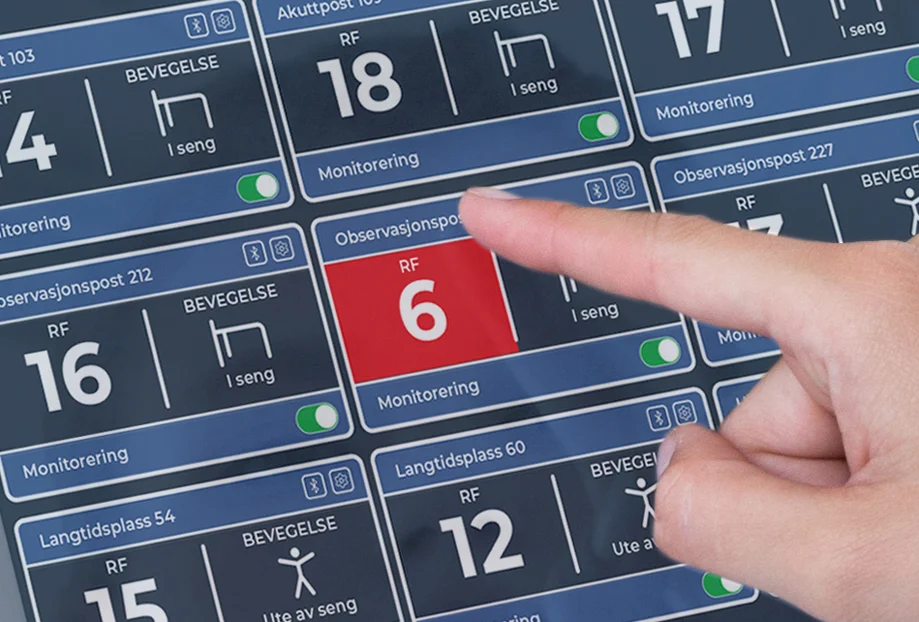
In the control room, staff get a real-time overview of all rooms. Green boxes mean everything is normal. Yellow means someone is approaching the limit. Red means act now.
Everything is GDPR-secured, everything is logged, and the system never replaces human judgment – it just gives you the information you need to make that judgment sooner.
Imagine a day where you no longer wonder if everything is okay in the quiet rooms. Where you get notified when something actually changes, not just hope that the schedule is right.
Where the night watchman can sleep a few hours without a guilty conscience, because the system is awake. Where patients can rest without being woken up for routine checks, because the monitoring happens anyway. And where the really serious incidents are caught early enough for you to do something about them.
It's not science fiction. It's everyday life in an increasing number of departments in Norway and Europe.
Is your department ready to take a breather?